
Talk with Admissions about upcoming class dates and whether automatic or manual CDL training fits your goals.

Classes are in-person at the school. No online classes.
– weekday classes
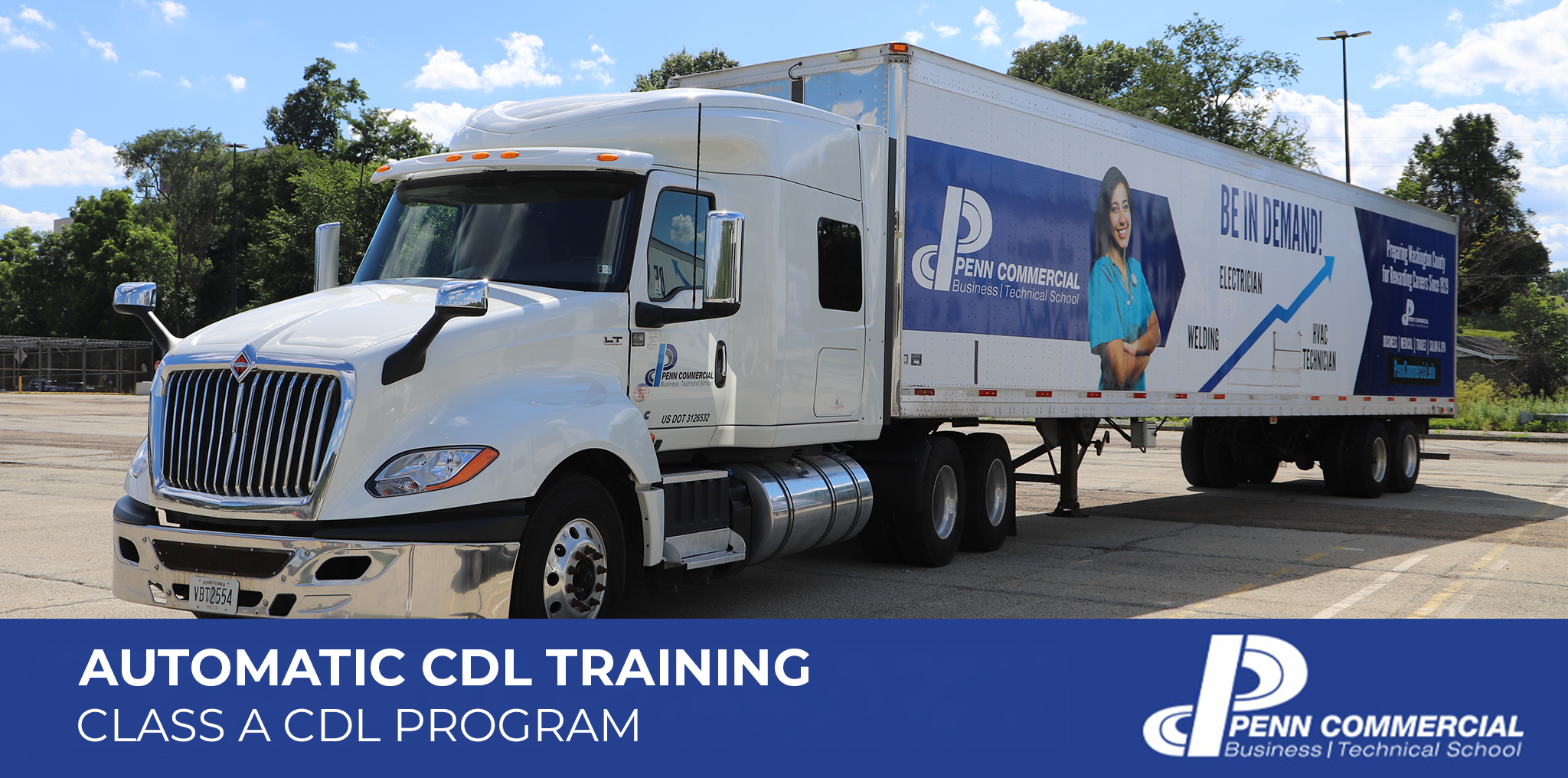
Train in a real automatic-transmission truck and complete Class A CDL training in as little as five weeks. Build the driving, backing, inspection, and safety skills needed to prepare for the Pennsylvania Class A CDL skills examination without the added complexity of learning to shift a manual transmission.
Many people are interested in becoming a commercial driver but feel intimidated by learning to shift gears in a large truck.
Penn Commercial’s automatic-transmission truck allows students to focus on vehicle control, backing maneuvers, road awareness, and CDL skills without the added complexity of clutching and shifting.
Many commercial trucking fleets now operate automatic-transmission trucks, making automatic CDL training a practical option for many new drivers entering the industry. Students still learn the inspections, backing maneuvers, safety procedures, and road skills needed to prepare for the Pennsylvania Class A CDL skills examination.
For many students, automatic CDL training offers a more approachable path into the trucking industry.

Students who complete their CDL skills test in an automatic-transmission truck earn a Class A CDL with an automatic transmission restriction.
Penn Commercial also offers manual-transmission CDL training for students who want the flexibility to operate both manual and automatic commercial vehicles.
Not sure which option is right for you? Our Admissions team can explain the differences between automatic and manual CDL training and help you choose the training option that best fits your career goals.
Examples of employers that have hired Penn Commercial graduates include:
Penn Commercial’s Career Services Department provides job-placement assistance through career counseling, resume assistance, job listings, and job fairs.
No. Penn Commercial’s automatic CDL training starts from the basics, and you do not need any prior experience with a manual transmission.
Yes. You can earn a Class A Commercial Driver’s License by testing in an automatic-transmission truck. Your license will carry an automatic transmission restriction.
An automatic restriction (Restriction Code “E”) means you took your road test in an automatic-transmission vehicle, so your license authorizes you to drive automatic commercial vehicles only. The restriction can be removed later by passing a CDL skills test in a manual-transmission vehicle.
Many of today’s major trucking carriers operate fleets that are largely or entirely automatic, so the restriction is not a barrier for the majority of entry-level driving jobs. We recommend asking each prospective employer about their fleet to be sure.
Many students find it less intimidating because they can focus on driving, backing, and safety instead of also learning to clutch and shift. The CDL test itself is still rigorous either way.
Automatic-transmission trucks are easier to drive, reduce fatigue on long routes, can be more fuel-efficient, and shorten on-boarding time for new drivers. As a result, much of today’s freight fleet is automatic.
The daytime program is approximately 5 weeks, with 200 hours of training.
A daytime schedule is currently available. Please talk with Admissions about upcoming start dates.
No. Students do not need to have a Pennsylvania Class A Commercial Learner’s Permit (CLP) before starting the program. During the first 40 hours of classroom instruction, Penn Commercial prepares students for the permit exam. Once students earn their permit, they begin behind-the-wheel training.
Graduates are eligible to take the Commonwealth of Pennsylvania Commercial Driver’s License practical and written examinations for a Class A commercial vehicle. With successful testing, you may earn air-brake-restriction-lifted designation and the tanker endorsement.
Yes. All behind-the-wheel training takes place in real commercial trucks — not simulators.
You must be 18 to drive intrastate (within Pennsylvania) and 21 to drive interstate. Federal Motor Carrier rules (Section 391.11) require interstate drivers to be 21 or older.
Tuition varies by program. Contact Admissions for current pricing and financing options.
Because our CDL program is shorter than the minimum length required for federal financial aid, it is not eligible for FAFSA funding. However, Penn Commercial works with PA Forward to help qualified students explore loan options that can assist with the cost of training. Our Financial Aid team can help you understand your financing options and answer any questions you may have.
Yes. Penn Commercial’s CDL program is registered with the Federal Motor Carrier Safety Administration’s (FMCSA) Training Provider Registry (TPR) as an Entry Level Driver Training (ELDT) course.
Penn Commercial’s Career Services Department provides job-placement assistance through career counseling, resume assistance, job listings, and job fairs.
Penn Commercial Business/Technical School is located in Washington, Pennsylvania, approximately 25 miles south of Pittsburgh.
Yes. Many trucking companies operate automatic-transmission fleets and hire drivers with an automatic transmission restriction. Job requirements vary by employer, so students should review employment opportunities based on their career goals.
In most cases, yes. Drivers can typically remove an automatic transmission restriction by passing a CDL skills test in a manual-transmission commercial vehicle, subject to current Pennsylvania and federal requirements. Because these requirements can change, we recommend confirming the current process with PennDOT or your Admissions representative.
Yes. Students learn vehicle inspections, backing maneuvers, road driving, safety procedures, coupling and uncoupling, and the other required skills needed to prepare for the Pennsylvania Class A CDL skills examination. The primary difference is that training and testing take place in an automatic-transmission truck.
Ready to start your CDL training? Talk with our Admissions team about upcoming class dates, financing options for those who qualify, and whether automatic or manual CDL training is right for you.